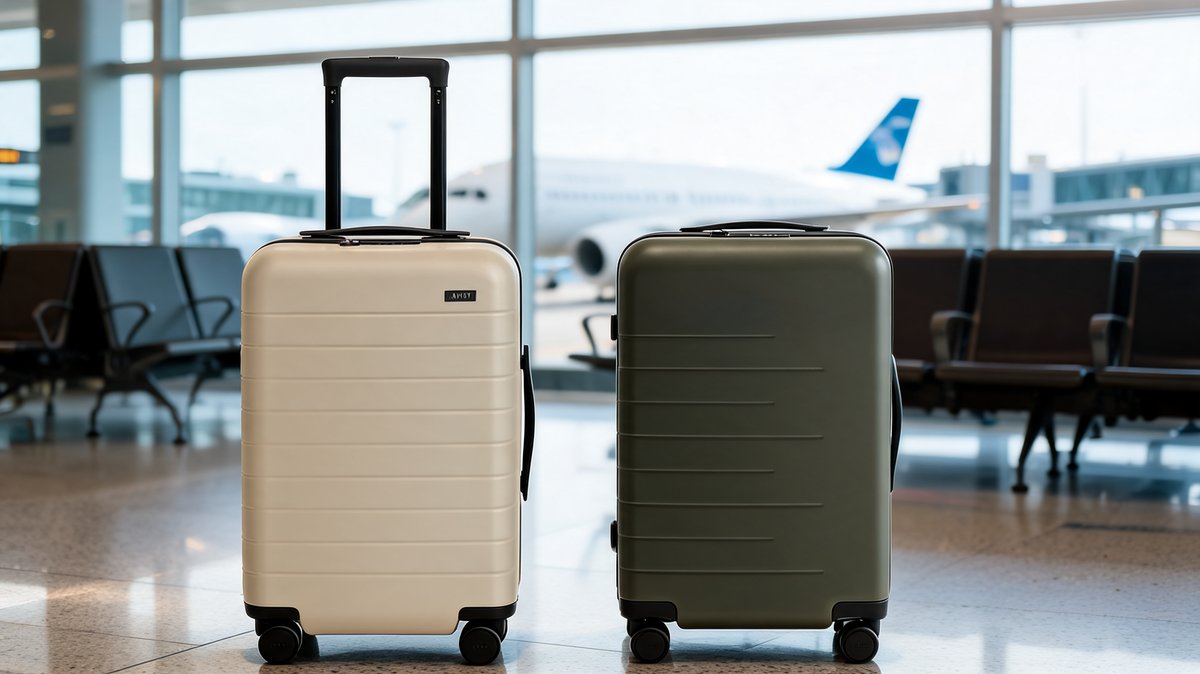
Quince and Away carry-ons look nearly identical - same silhouette, same clamshell layout, same compression panel inside. But they're not the same bag. Quince costs about $129 versus Away's $275, weighs 1.3 lbs less, and comes with Hinomoto wheels on the standard model. Away has a more refined shell feel, 20+ color options, and a track record stretching back nearly a decade. For most travelers, Quince is the better value. Away earns its price if feel and brand confidence matter to you.
| If you want… | Buy… |
|---|---|
| The lowest price | Quince (~$129) |
| Premium material feel and finish | Away ($275) |
| The lightest option | Quince (6.2 lbs vs 7.5 lbs) |
| More than 20 color options | Away (20+ colors) |
Quince vs. Away: Side-by-Side Specs
| Spec | Quince Carry-On 20" | Away The Carry-On |
|---|---|---|
| Exterior dimensions | 22" H × 14.4" W × 9.1" D | 21.7" H × 14.4" W × 9" D |
| Weight | 6.2 lbs | 7.5 lbs |
| Capacity | 40L | 39.8L |
| Price | ~$129 | $275 |
| Shell material | Polycarbonate | Polycarbonate |
| Wheels | Hinomoto 360° spinner | 360° spinner (manufacturer undisclosed) |
| TSA lock | Yes | Yes |
| Laundry bag | Yes | Yes |
| Warranty | Limited lifetime | Limited lifetime |
| Return window | 365 days | 100 days |
| Colors available | 6–8 | 20+ |
How Similar Are These Two Bags, Really?
Place both bags side by side and you'd struggle to tell them apart from across the room. They share the same exterior grooves, black hardware, four-spinner wheel setup, zipper-and-lock closure, and internal layout. The dimensions are nearly identical - Quince is 0.3 inches taller and 0.1 inches deeper than Away, differences you won't notice rolling through an airport.
The similarity isn't coincidental. Quince built its entire brand around delivering the look and function of premium products at a fraction of the price - luggage included. Whether that's flattering or something else is a debate for another day. What matters here is practical: these bags do the same job, carry roughly the same amount, and meet the same airline limits.
That said, specs on paper only tell part of the story. The details - shell texture, wheel quality, interior pockets, hardware durability - are where the $146 price gap either justifies itself or doesn't. That's what the rest of this comparison covers.
Price: The Number-One Factor
The $146 Gap
The math is straightforward. Quince runs about $129; Away is $275. That's a $146 difference - enough to cover a round-trip domestic flight on a budget carrier, a week of meals on a frugal trip, or a solid set of packing cubes with cash to spare. You could buy two Quince carry-ons and still spend less than a single Away.
Away's price has stayed at $275 for years, through multiple model iterations. Quince pricing fluctuates - it dips lower during sales - but the street price typically sits near $129. This isn't a situation where the premium option is only slightly more expensive.
One clarification worth making: Away's price isn't unjustifiable. A bag that lasts 7–10 years at $275 is less expensive per year than a $129 bag that needs replacing in three. The durability question is covered in the owner feedback section below. But the upfront cash difference is real and matters for most buyers at this price point.
What Away Removed but Kept Charging For
Away originally went viral for a specific feature: a built-in USB battery pack that let you charge your phone from the bag itself. That feature was a genuine differentiator in 2015, when portable chargers weren't ubiquitous. Away removed it from current models - citing TSA friction (batteries must be removable for checked bags) and the reality that most travelers carry their own power banks anyway.
The price stayed at $275.
Reactions from long-time Away owners have been mixed. Some are fine with it - "they dropped the battery pack that I had to remove every single flight" is a complaint that surfaces repeatedly in travel forums. Others feel the removal weakened the value proposition. Either way, the current Away Carry-On and the current Quince Carry-On are now on equal footing: neither has a charging feature. Quince's simpler design isn't a drawback relative to Away anymore.
Build Quality: Shell, Wheels, and Hardware
Polycarbonate Shell - What "Thinner" Actually Means
Both bags use polycarbonate shells, which is the right material for a hard-sided carry-on - lightweight, impact-resistant, and flexible enough to absorb knocks without cracking. The difference between them isn't structural; it's tactile.
Away's shell has a more refined texture and a firmer, more solid feel when you press on it. Quince's shell has slightly more give - a subtle flex that some testers describe as thinner. One owner in a carry-on luggage forum noted that Quince "was thinner than my Away luggage," while another who owns both said they're "indistinguishable from each other in aesthetic and quality." That range reflects the reality: some people notice the difference, others genuinely don't.
Neither bag failed a shell test in any editorial review. Testers tossed Quince down a cement driveway five times (Business Insider), dragged it over rocky streets, and flew it on multiple round trips - scuffs appeared, structural damage didn't. Away's polycarbonate shell has an even longer track record of surviving airports without cracking. Both are functionally durable. Away simply feels more premium the moment you touch it.
Wheels - Quince's Underrated Advantage
Here's a detail that most Quince vs. Away comparisons bury or miss: the standard Quince Carry-On uses Hinomoto wheels. Hinomoto is a Japanese manufacturer widely regarded in the luggage industry as the gold standard for spinner wheels - quiet, smooth, and long-lasting. Several premium luggage brands use them as a selling point.
Away's current carry-on uses a different wheel. When a travel blogger asked Away's customer service which manufacturer makes their wheels, the answer was vague. Away's older models used Hinomoto; the newer ones do not, and the brand hasn't specified what replaced them. Some owners of recent Away models report wheels that aren't as smooth as they expected.
Wheel quality is one of those specs that only reveals itself over time and miles. But on paper, Quince has the named, premium-wheel advantage here - which runs counter to the assumption that the cheaper bag must cut corners on rollers.
Zippers, Handles, and Hardware
Quince uses YKK zippers, which is a meaningful quality signal. YKK is the world's largest zipper manufacturer and a benchmark for reliability - their zippers are used in everything from high-end outdoor gear to premium luggage. The telescopic handle on the Quince has also performed well in hands-on tests; one tester specifically called out the handle feel as more comfortable than Away's.
Away edges ahead on side handles and top grab handles, which feel sturdier. Away also includes a leather luggage tag in the box; Quince doesn't. That's a small thing, but if you factor in purchasing a tag separately (typically $10–$20), the price gap narrows slightly.
Interior Organization and Packing
The interiors of these two bags are nearly the same. Both use a clamshell layout that opens flat, with a compression panel on one side - two buckle straps that cinch down over your clothes - and a zippered mesh section on the other for shoes, electronics, and accessories. Both include a laundry bag with a snap closure that tucks into its own zipper pocket.
The one meaningful difference: Away added three interior zippered pockets to its current model after removing the battery. Quince has a single zippered pocket on the mesh side plus the compression section. Away's extra pockets are useful for organizing smaller items - socks, charging cables, toiletry pouches. It's not a dramatic difference, but it's there.
Capacity is essentially the same: 40L for Quince, 39.8L for Away. In real terms, both bags will comfortably hold three to five days of clothes with normal packing. With packing cubes and some discipline, six to seven days is realistic. Travelers in carry-on luggage communities who've tested both bags consistently report no meaningful packing advantage for either one - and at least one owner noted they could fit more into the Quince than into their previous softside bag from a different brand.
Airline Compatibility: Do Both Bags Fit?
Major U.S. Airlines
Both bags comply with the standard carry-on limits at major U.S. carriers. Here's how the dimensions compare:
| Airline | Size limit | Quince 20" (22"×14.4"×9.1") | Away Carry-On (21.7"×14.4"×9") |
|---|---|---|---|
| Delta | 22"×14"×9" | ✅ Complies | ✅ Complies |
| United | 22"×14"×9" | ✅ Complies | ✅ Complies |
| American | 22"×14"×9" | ✅ Complies | ✅ Complies |
| Southwest | 24"×16"×10" | ✅ Complies | ✅ Complies |
One nuance: the Quince at 22" H is exactly at Delta's, United's, and American's stated limit. Away at 21.7" H has a 0.3-inch buffer. In practice, gate agents rarely break out a measuring gauge for hard-sided carry-ons unless there's an obvious size issue. But if you're the type who travels anxious about gate checks, Away's slight size advantage is real - even if it rarely matters.
For full airline-by-airline size requirements, see our airline carry-on requirements guide.
International Travel
Both standard models comply with most major international airline carry-on limits. You can fly either bag on British Airways, Lufthansa, Air France, and similar carriers without issue.
One important caveat: if you're considering the Quince Expandable Carry-On (a larger 21" model with dimensions of 22.8" × 15.6" × 10.5") rather than the standard 20" model, that bag will likely not fit in overhead bins on European budget carriers like Ryanair or easyJet. CNN Underscored's tester bought the expandable version specifically for a two-week European trip before realizing it wouldn't work. Stick with the standard 20" Quince if international compatibility is a priority.
Warranty and Return Policy
Both bags carry a "limited lifetime warranty" - the same language, the same coverage. Cracks in the shell, broken or non-functional wheels and handles, and zippers that no longer open or close are covered. Cosmetic damage, normal scuffing, and damage from mishandling or airline baggage handlers are not.
The practical difference is in the return window. Quince offers 365-day free returns; Away allows returns within 100 days. That extra 265 days matters if you want to test the bag through a full year of travel before committing. However, there's a Quince-specific caveat worth knowing: if your original payment method's refund window has expired (which can happen with PayPal, Apple Pay, or Google Pay), Quince may issue store credit rather than a cash refund. Business Insider surfaced this, and it's buried in Quince's return policy. Read it before buying.
Away's warranty reputation is more established - the brand has been in business since 2015 and there are plenty of firsthand accounts of successful claims. Away's Trustpilot score, however, sits at 1.8 out of 5, with many reviewers citing slow or unhelpful customer service responses. That's worth knowing. A great warranty only helps if the process of using it isn't a nightmare.
What Actual Owners Say
We spent time in carry-on luggage forums and travel communities looking for people who had used both bags - not just one or the other. The pattern that emerges is useful but nuanced.
The dominant view among travelers who own both is that the bags are functionally comparable. One traveler who uses both regularly put it plainly: "They are both well made and sturdy - indistinguishable from each other in aesthetic and quality." Another frequent flier who switched from Away to Quince said: "I can honestly say the quality is pretty much the same, for about half the price."
The main dissenting view is about shell feel, not performance. One owner noted: "I've been impressed with all but a few things - the luggage was thinner than my Away luggage." That matches what we see in editorial reviews: people who care about tactile quality notice the difference. People who care primarily about function often don't.
The honest caveat here is about time. Away has been on the market since 2015 - there are travelers who've logged 7 or 8 years and hundreds of flights with the same bag. Quince only launched their luggage line more recently, so the 5-to-10-year durability picture is still being written. Away's longer track record is a real advantage if you're buying a bag you want to use for a decade. If you're buying a bag you expect to use for 3–5 years and then reassess, that gap matters less.
Our Verdict
Buy Quince If…
- Price is a real factor. Saving $146 is meaningful - that's a hotel night, a flight upgrade, or a proper luggage scale.
- You want the lightest option. At 6.2 lbs, Quince is 1.3 lbs lighter than Away. That's relevant on airlines with weight-sensitive carry-on limits.
- You're new to carry-on-only travel. Quince is an excellent bag to test the format without committing $275 to a lifestyle change.
- You prefer clean, minimal interiors. Quince's interior is unbranded; Away's is logo-heavy.
- You're fine with 6–8 color choices. Quince's range is smaller but covers the basics.
Buy Away If…
- Material feel matters to your experience. Away's shell, handles, and overall finish feel more refined - and if you're paying $275, that premium feel is part of what you're getting.
- You want extensive color and customization options. Away offers 20+ colors plus monogram options.
- You travel heavily and want proven longevity. Away's decade-long track record is still the most evidence-backed story in this comparison.
- You want a cleaner customer service experience on paper - though Away's actual Trustpilot score should temper that expectation.
Also Worth Considering
If budget is the primary driver, the Bugatti Lisbon Carry-On is worth a look at $80 - it hits the standard 22" × 14.25" × 9" dimensions at just 5.5 lbs, making it lighter than both Quince and Away. For a full spec-by-spec comparison across bags, use our carry-on comparison tool.
Frequently Asked Questions
Is Quince the same as Away?
Not exactly, but very similar. Both use polycarbonate shells, 360° spinner wheels, TSA-approved combination locks, and clamshell interiors with compression panels. The main differences are price (Quince ~$129 vs. Away $275), weight (Quince is 1.3 lbs lighter at 6.2 lbs), Away's slightly more refined shell texture, and Away's significantly larger color selection (20+ vs. 6–8).
What is Quince luggage a dupe of?
Quince luggage is widely described as an Away carry-on dupe. The design, dimensions, and interior layout closely mirror Away's flagship carry-on. Quince has not confirmed this publicly, but hands-on comparisons and side-by-side photos consistently note the near-identical appearance and feature set.
Is Quince luggage worth it?
For most travelers, yes. At ~$129, Quince delivers the core features of Away's $275 carry-on - hard polycarbonate shell, Hinomoto spinner wheels, YKK zippers, TSA lock, compression interior, and a laundry bag - for less than half the price. The main tradeoffs are fewer color options and a shell texture some users describe as slightly less refined than Away's.
Does Away still include a battery in their carry-on?
No. Away removed the built-in USB battery pack from their standard carry-ons in recent years, citing TSA complications and the prevalence of standalone power banks. The current Away Carry-On has no charging feature. The price, however, has remained at $275.
Which is better for international travel - Quince or Away?
For most international travel, both the standard Quince 20" and Away Carry-On comply with major international airline carry-on limits. If you're considering the Quince Expandable Carry-On (a larger 21" model at 22.8" × 15.6" × 10.5"), note that it may not fit on European budget airline overhead bins. Stick with the standard 20" Quince for the broadest international compatibility.

